
At Bandex, we excel as experts in the manufacturing and trading of rubber elastic bands, a product regulated under the European Union Deforestation Regulation (EUDR), which has been in effect since December 2022.
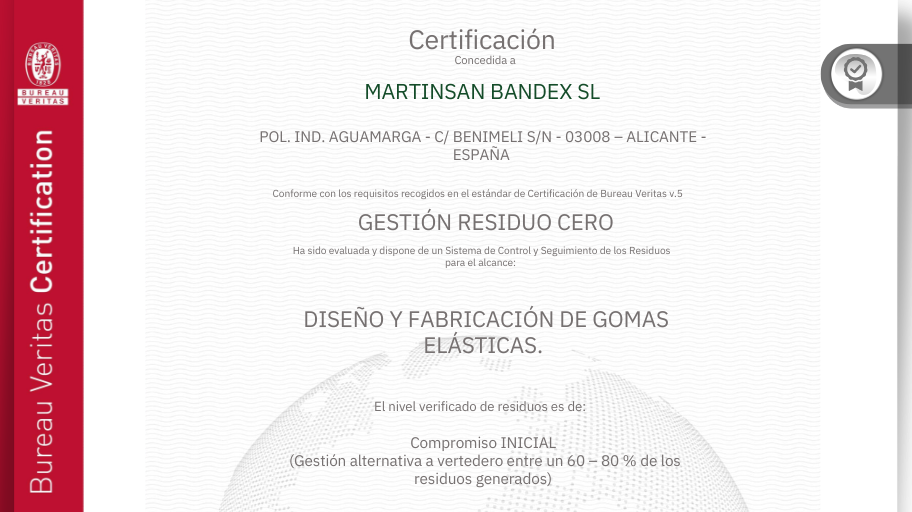
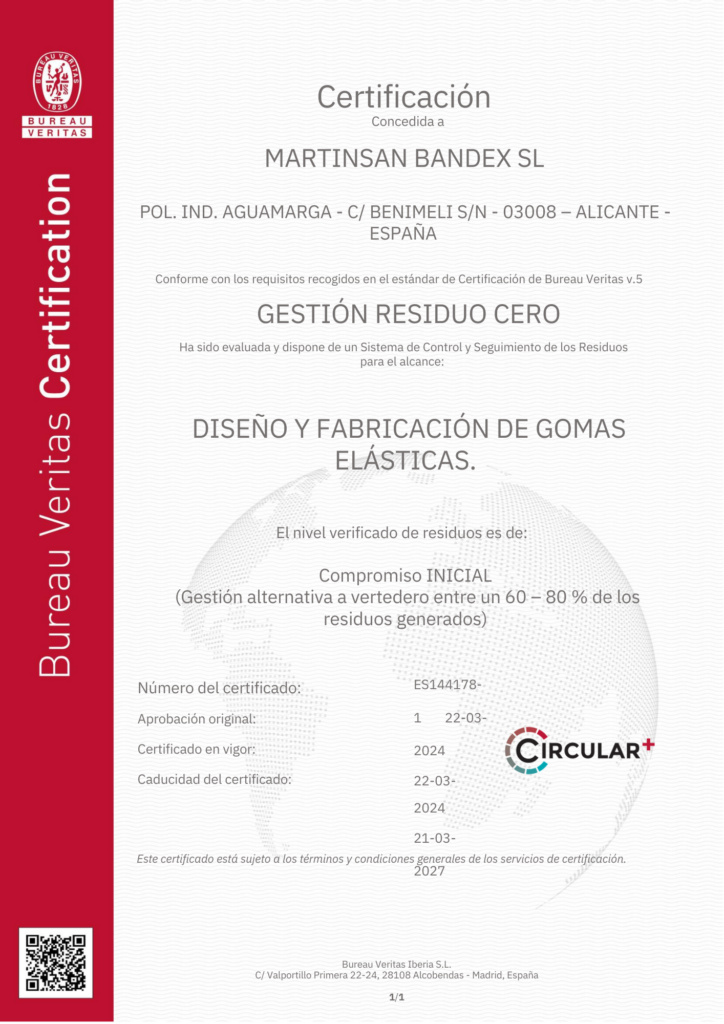
Adhering to this regulation, we strive to minimize environmental impact at every step of our production process and implement waste reduction strategies. This commitment is reflected in our achievements, including receiving the prestigious Zero Waste certification from Bureau Veritas for the second consecutive time, a testament to our dedication to sustainability and respect for our planet.
Achieving Zero Waste to Landfill Certification for the Second Consecutive Time
Since 2018, Bandex has implemented a Sustainability Strategy that has marked a significant milestone in the company’s environmental management. This strategy has materialized through a robust and effective Waste Management System, ensuring a more efficient production cycle.
This system is based on waste reduction, reuse, and recycling principles, thereby minimizing residues in landfills. Additionally, it promotes a culture of sustainability within the organization.
Therefore, this April, we received the Zero Waste to Landfill certification from Bureau Veritas for the second consecutive time, with an alternative landfill management level of 60 – 80% of generated waste.
This approach aligns with the best environmental and sustainability practices and reinforces Bandex’s commitment to ecological responsibility and innovation in its production processes.
Environmental Impacts
The overexploitation of natural and synthetic resources for product manufacturing is a growing problem affecting numerous sectors, including the rubber industry. This process involves the intensive extraction of raw materials and generates significant environmental waste at each stage of the product life cycle, from extraction and manufacturing to final disposal. Not to mention the considerable ecological impacts during intermediate phases, such as transportation and distribution.
Transitioning to a circular economy model for industries manufacturing rubber products represents a viable and sustainable solution. In a traditional linear system of “resource-product-waste,” materials are extracted, used, and ultimately discarded, leading to a loss of value and the generation of large amounts of waste.
In contrast, the circular economy model proposes a continuous cycle of “resource-product-recycled resource-recovered,” where materials are used for as long as possible, recycled at the end of their useful life, and reintegrated as resources for new products.
Implementing this transformation in the rubber industry can involve several strategies:
- Design for recyclability: Develop rubber products designed from the outset to be easily recyclable at the end of their useful life, reducing the complexity and mixed materials that complicate recycling processes.
- Recovery and reuse of waste: Utilize rubber waste as raw material for manufacturing new products. This reduces the demand for virgin resources and decreases the amount of waste ending up in landfills.
- Use of recycled rubber: Incorporate recycled rubber into producing new rubber products, which can significantly reduce the production’s environmental footprint.
- Innovation in production processes: Improve manufacturing process efficiency to reduce waste generated and energy consumed.
To recognize the efforts of organizations advancing towards a circular model, Bureau Veritas has developed its scheme to verify and identify the amounts of waste generated that avoid landfills as a destination, utilizing other avenues such as recovery, recycling, or valorization.
What is the Zero Waste to Landfill Certification by Bureau Veritas?
Bureau Veritas is a global company providing testing, inspection, and certification (TIC) services. Founded in 1828 in Belgium, the company operates across a wide range of sectors, including construction, automotive, industry, aerospace, oil and gas, and mining.
Its services range from product and system validation to environmental compliance assessment and risk management. Its mission is to improve companies’ performance in managing and mitigating risks, enhancing sustainability, and optimizing operational efficiency.
The “Zero Waste to Landfill” certification recognizes companies implementing effective waste management practices to minimize the waste they send to landfills. This certification implies that companies have achieved a very high material recycling rate, reuse, or recovery, ideally approaching 100%, meaning virtually no operational waste ends up in landfills.
The process to obtain this certification includes a rigorous evaluation of the company’s operations, including waste segregation, process optimization to reduce waste generation from the start, and implementing systems to recover and recycle materials whenever possible. Reuse strategies for waste are also valued, such as converting waste into energy.
What Does Achieving Zero Waste to Landfill Certification for the Second Consecutive Period Mean for Bandex?
To Bandex, this certification is crucial for two reasons. First, it demonstrates our concern and commitment to sustainability and the environment. Second, it is a recognition of the effort and dedication of the Bandex team, who have worked hard to achieve this goal.
The Zero Waste certification requires great discipline to maintain work procedures and continuously question current processes, always seeking improvements in waste reduction, recycling, reuse, and eliminating hazardous and polluting substances. This effort benefits the environment and has allowed us to reduce material consumption, improve energy efficiency, and lower costs associated with waste management.
Bandex Strategies for Waste Reduction
Currently, we are working on several innovative strategies to improve our internal processes and demonstrate that innovation and sustainability can go hand in hand. Among them:
- Rubber Recycling
We have implemented a devulcanization process in collaboration with Plymouth, a French company specializing in plastics. This thermo-mechanical process breaks the sulfur and carbon bonds in waste rubber, allowing it to be reused without compromising the quality of the final product. This will reduce our waste by 15 tons annually.
- Pallet Recycling
We have implemented a pallet management system that includes reusing, repairing, and recycling pallets used in our operations.
- Reduction of Packaging Materials
We analyze and optimize our packaging processes to reduce the materials used without compromising the integrity of our products.
- Reduction of Production Waste
We have developed an efficiency plan for our production lines to minimize waste and scraps generated. Additionally, we have established monitoring and tracking systems to identify areas for improvement and continuously optimize our processes.
Our Ongoing Commitment
Guided by our commitment to respect the planet and the desire to reduce the environmental impact of our activities, we aim to apply responsible waste management practices across all processes in our value chain. This involves minimizing waste generation and ensuring sustainable production and consumption methods.
We will carry out our activities by valuing the various wastes generated, attempting to reintroduce them into the market, and avoiding their final disposal in landfills. We will also promote using recycled materials and renewable energies such as solar thermal energy.
Our commitment to the environment requires a three-dimensional execution plan: production processes, products, and people.
The zero-waste-to-landfill certification is just the beginning. It is our contribution towards a more sustainable future. Will you join our team?